Ethiopian Coffee: A Tradition That Brings People Together
For Ethiopians, coffee is far more than a drink. It is a way more integrated to a day to day life involving conversations, peace-makings, counseling sessions, and often the heartbeat of community life. While much of the world begins its day with a hurried cup of coffee on the go, Ethiopians have long embraced a different philosophy: coffee is not something to be rushed. It is a quality time to be shared.
Arabica coffee, which makes up the majority of coffee consumed worldwide, is largely acknowledged to have originated in Ethiopia. Coffee is ingrained in Ethiopian culture, from the foggy mountains where wild green coffee beans get collected to the villages where neighbors congregate around a cozy coffee ceremony.
Ethiopians celebrate coffee, not just make it. It is not merely consumed; it is honored. The Ethiopian coffee ceremony, one of the country’s most treasured day to day tradition, it just turns a caffeine drink into a rich social custom that fosters fellowship, fortifies families, and maintains close-knit communities.
 Ethiopia, The Land of Origins
The discovery of iconic fossils like Lucy, Ardi, and Selam in Ethiopia is not the only fact depicted in this phrase. Coffee Arabica calls Ethiopia its home. Legend tells of a young goat herder named Kaldi who noticed his goats dancing energetically after nibbling bright red berries from a certain shrub. He shared his discovery with a monk who grew berries close to his monastery, improved the roasting, grinding, and brewing process, and discovered that coffee kept monks awake and focused during their devotions.
In the lush forests of South-Western Ethiopia, coffee has grown naturally for centuries. Long before coffee became a global commodity, Ethiopians were cultivating, harvesting, and drinking it. Ethiopia is still a living treasure trove of coffee biodiversity, with thousands of native coffee varieties that are unique to the nation. One could say Ethiopia is, in many respects, the wellspring of coffee, much like the spring is to the river.
Ethiopian coffee is commonly referred to in almost reverent terms by coffee enthusiasts worldwide, and for good reason. The country’s high altitudes, fertile soils, and favorable climate create ideal growing conditions. Ethiopia’s diverse range of Arabica coffee varieties and its ideal climate have contributed to Ethiopia’s appeal on international markets, particularly for its gourmet, specialty, and organic coffee. Ethiopian coffee is rich in acidity. It has a winey, spicy, floral, or mocha flavor and is sweet and fragrant. Ethiopian coffee is often used to blend and improve coffees made in other nations for its fragrances and flavors. This is why Ethiopian coffee continues to command premium prices in specialty markets. According to the Ethiopian Coffee and Tea Authority, Ethiopia exported a record 470,000 tons of coffee generating over $2.6 billion USD in revenue in the most recent fiscal year (ending 2024–2025). More over 40% of the country’s entire agricultural export revenue came from this performance.
 The Ethiopian Coffee Ceremony, From Bean to Cup
In Ethiopia, the ceremony where coffee is to be served is the warmest, welcoming and graceful experience. Nonetheless, it is not intended for those who are keeping an eye on the clock. Participants are reminded that the best things in life cannot be hurried as it unfolds slowly and meticulously.
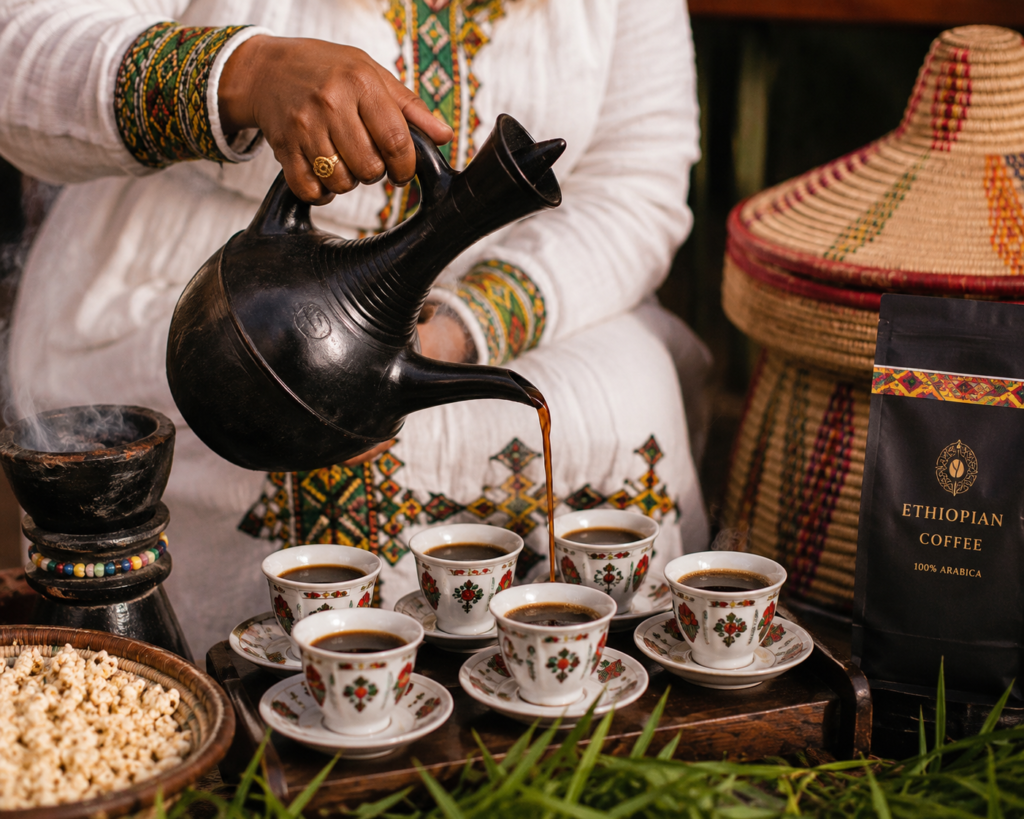
The process begins with careful preparation of the gathering space. Fresh grass is spread across the floor, filling the room with the scent of nature. The air is softly filled with incense, which creates a calm and inviting atmosphere.
Neighbors, relatives, friends, and visitors gather together. Some arrive to exchange greetings; others come seeking advice, companionship, or simply a moment of connection. Then the ceremony begins.
The host starts by washing the green coffee beans till the beans get well clean. Next comes the roasting. Typically, the host is seated in front of a small charcoal stove on a wooden stool and there is a smoldering incense burner aside.
The beans are roasted over an open flame in a flat pan while turning them regularly. As they darken and crackle, there comes the aroma which wafts around to entice additional visitors. The host often carries the roasting pan around the gathering, allowing everyone to inhale the smoke from the coffee beans been roasted.
Once roasted brownish, the beans are ground using a regular mortar and pestle. The freshly ground coffee is then brewed in a Jebena, the iconic clay coffee pot with an elegant shape. The Jebena slowly releases the sense-of-taste of a brew while resting over hot coals, making it enjoyable to smell even before you take a sip.
When the coffee is ready, it is served in small cups known as Finjal_/_Sini, orderly arranged on a Rekebot, a beautifully crafted serving tray.
During the coffee time in Ethiopia offering crunchy snacks that enhance the enjoyment is also common. Guests are typically served Kolo, which is made from dry-roasted barley often mixed with peanut or chickpeas.
Traditionally, the ceremony comes with three rounds of coffee: The first round, Abol, introduces the freshly brewed coffee. The second round is called Tona, and the final round, Baraka, meaning “blessing.” In particular, the final section of the session is considered to bestow a blessing and a prayer, you never want to miss.
A Moment Whereby More Value Is Given to Human Relations
Perhaps the most remarkable aspect of Ethiopian coffee culture is what happens between the first sip and the last. Coffee gatherings are often the village square in miniature. Here, neighbors discuss community concerns. Friends exchange life updates. Elders share wisdom earned through experience. Young people seek guidance about marriage, work, and family responsibilities. New mothers learn from experienced parents. Families exchange health updates and check on elderly neighbors and so much more.
A coffee invitation in Ethiopia is rarely just about a drink. It is where misunderstandings are cleared up before they grow into conflicts. It is where advice is given freely and received gratefully. It is where people lend an ear to someone carrying a heavy burden. Those facing personal challenges discover encouragement. In a world where many people feel disconnected despite being constantly connected online, Ethiopian coffee culture reminds us that a community thrives when fellow people sit together, talk together, laugh together, and sometimes even cry together.
Ethiopia, the origin of Arabica coffee, has given the world much more than just a drink; it has contributed a timeless custom that prioritizes interpersonal relationships in daily life. The Ethiopian coffee ceremony serves as a potent reminder that face-to-face conversation, respect, and shared experiences are the foundations of enduring peace, strong communities, and meaningful connections in a world increasingly molded by speed, isolation, and digital interactions. Therefore, preserving and promoting this distinctive tradition is not just a celebration of Ethiopia’s rich past but also an assertion of principles that the world needs more than ever: humanity, unity, and communication.  Hanna Damtew Alamayehu / African Updates